History
Ground held in trust since 1892
How a ten-year-old lodge in a fifteen-year-old town bought a burying ground from the founder's widow, and what has happened on it since.
Part one
The purchase
Johnson City was barely a town when its Masonic lodge was chartered on December 16, 1882. James Polk Johnson had laid out the townsite on his own land along the Pedernales only a few years earlier, and the county seat would not move here from Blanco until 1890. The lodge's founders were the same men founding everything else: the school, the churches, the county offices, the first stores on the square.
A town needs a place for its dead, and by 1892 the lodge had decided to provide one. On December 3, 1892, the brethren appointed three of their number — Joseph Bird, a pioneer preacher and twice county judge; W. H. Withers; and G. M. Nash — to select and purchase a cemetery site. They bought it from Julia Ann Moore Johnson, the widow of James Polk Johnson, who had died in 1885. The deed is recorded in Volume 15, page 77 of the Blanco County deed records.
The lodge did not build the cemetery for itself. Its own standard operating procedure, written a century later, puts it plainly: the cemetery “was established simply to provide the citizens of the town a place to inter their dead. There are no restrictions as to church membership, lodge membership, family relationships, etc.” Lots were sold to anyone, and a deed was given to the purchaser.
1894 plat
The 1894 plat of the Masonic Cemetery of Johnson City, surveyed by Lambert Koeniger and filed with the county clerk March 23, 1896.
Part two
Blocks and lots
A cemetery is not just land; it is land divided so that every grave can be found again. On January 20, 1894, surveyor Lambert Koeniger swore before notary J. R. Brown that his plat “shows the true location of the blocks and lots of the Masonic Cemetery of Johnson City, Texas, and that the survey of same blocks and lots were actually made in the field.” The plat was filed with county clerk John A. Dendrich on March 23, 1896, and recorded the next day.
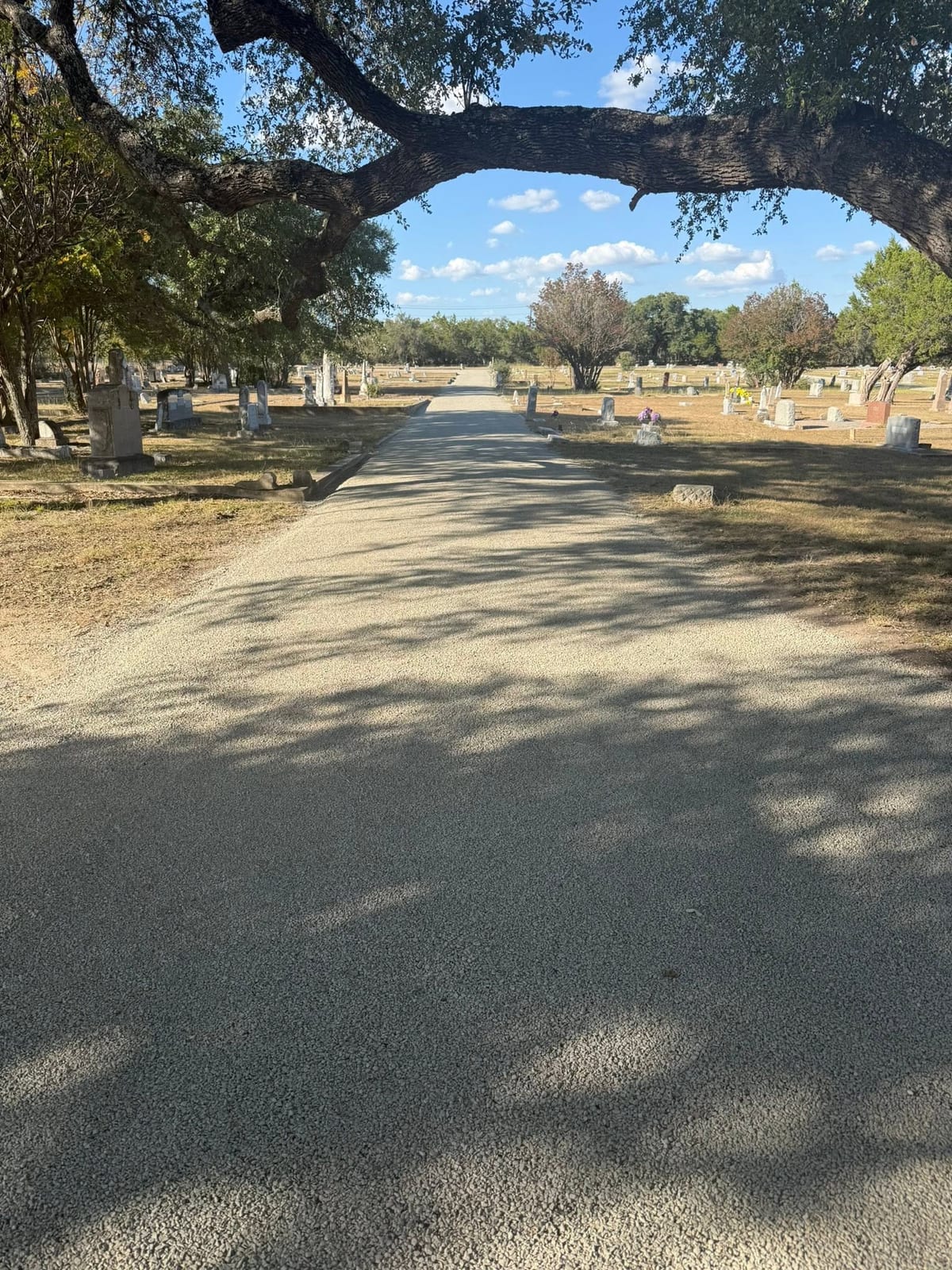
That plat is the original section — what the lodge calls the historic section, lying north of the entry lane. Its family lots are marked by the concrete and stone curbing typical of Hill Country cemeteries of the period, and its stones carry the names on the town's streets: Johnson, Moore, Withers, Nash, Lambert. The earliest marked graves date from the 1890s. Texas Ranger Cicero Rufus Perry, who died at Hye on October 7, 1898, was buried here that month.
By the 1950s nearly every lot in the historic section had been sold, and the lodge began looking for room to grow.
Part three
Miss Hattie's gift
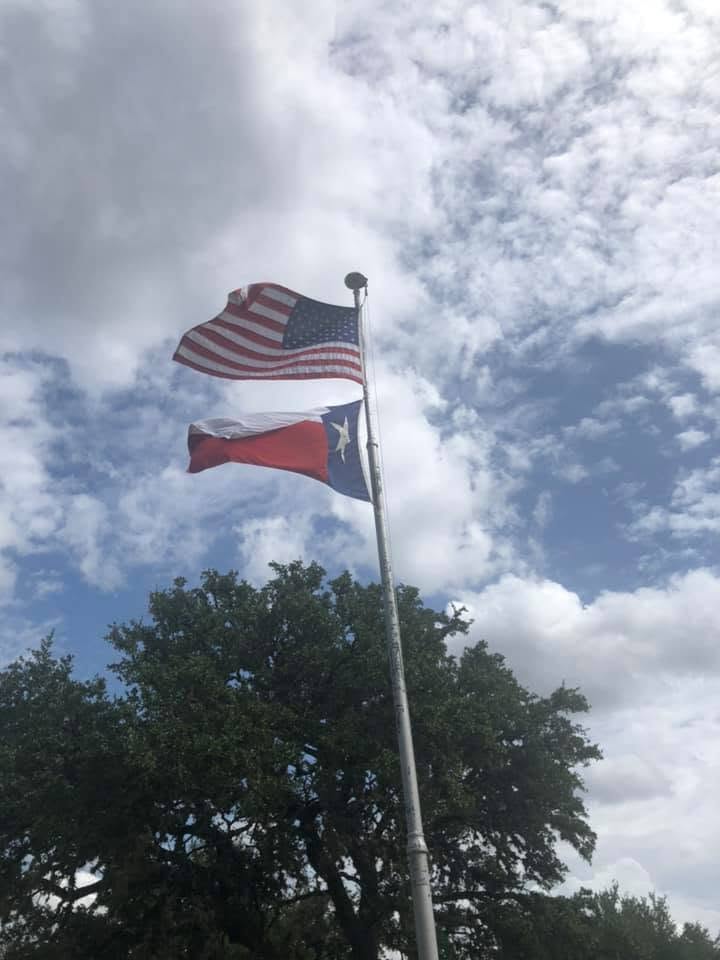
Room came from the Casparis family. Harriett “Hattie” Casparis Sharp (1899–1992), wife of George Washington Sharp and for years an accountant and real-estate agent with an office in the Sharp Building on the square, gave her land to her nephews. To William Howard “Bill” Casparis went the Pedernales place she called El Regalo, “the gift.” To his brother John Christian “Jake” Casparis went the tract south of the old cemetery, and he gave it, 2.01 acres, to the lodge in her memory. The lodge raised a marble monument to “Miss Hattie” in the new section and set a flagpole beside it to dress the ground; she herself lies beside her husband in lot L12 of the historic section. Lots in Casparis Section A were being sold by 1988. The gift deed is recorded in Volume 113, page 94.
After J. C. Casparis died, his heirs sold the lodge a further 3.26 acres to the east (Volume 367, page 614). The lodge bought it with two purposes in mind: to extend the cemetery eastward, with a place for graveside ceremonies, and to hold a future lodge hall with adequate parking. Both purposes are being fulfilled now.
In 2007 the lodge had the whole ground resurveyed by registered surveyor Floyd Ward of Accutex Survey Systems, and in May 2008 — acting through Cemetery Committee chairman Mike Park and Worshipful Master Johnny Hudson — it formally dedicated all 10.523 acres exclusively to cemetery purposes under §711.034 of the Texas Health and Safety Code. The southern and eastern ground was platted as Casparis Sections A, B, and C, recorded in May, October, and November 2008, with Worshipful Master George D. Stearns signing the later two. Every space in those sections is numbered on a recorded plat, which is what allows the lodge to sell a specific space and issue a deed for it.
The three sections
- Historic section — the 1894 Koeniger plat, north of the entry lane. Full.
- Casparis gift — 2.01 acres south of the old section: Casparis Section A around Miss Hattie's monument and the flagpole, and the Watson Section beside it.
- Eastern tract — 3.26 acres bought from the Casparis heirs; Casparis Section C and the site of the new lodge hall. The columbarium stands in Casparis Section B, along the west fence.
At a glance
Timeline
Dates are taken from the Blanco County deed records, the lodge's minutes and cemetery procedure, and the Texas Historical Commission marker.
1876–79
Johnson City is founded
James Polk Johnson lays out the town on his land along the Pedernales. The county seat moves here from Blanco in 1890.
Dec. 16, 1882
Lodge No. 561 is chartered
The Grand Lodge of Texas charters Johnson City Lodge No. 561, A.F. & A.M. Its members will found the cemetery a decade later.
Dec. 3, 1892
Three brethren are sent to buy a burying ground
The lodge appoints Joseph Bird, W. H. Withers, and G. M. Nash to select and purchase a cemetery site. They buy the land from Julia Ann Moore Johnson, widow of the town founder, and the deed is recorded in Volume 15, page 77 of the Blanco County deed records.
Jan. 20, 1894
The plat is surveyed
Surveyor Lambert Koeniger swears before notary J. R. Brown that his plat shows “the true location of the blocks and lots of the Masonic Cemetery of Johnson City.” The plat is filed with the county clerk on March 23, 1896 (Volume 15, page 80).
1890s
The first burials
The earliest marked graves date from the 1890s. Texas Ranger Cicero Rufus Perry, who died in 1898, is among the first of the county's founding generation to be laid to rest here.
1950s
The original section fills
By the 1950s almost every lot in the original section has been sold, and the lodge begins looking for room to grow.
1980s
The Casparis gift
John Christian “Jake” Casparis gives the lodge 2.01 acres south of the old section in the name of his aunt, Harriett “Hattie” Casparis Sharp (1899–1992), from whom the land had come. A marble monument to “Miss Hattie” and a flagpole are raised there, and lots in Casparis Section A are being sold by 1988. After the Casparis brothers' deaths, the heirs sell the lodge a further 3.26 acres to the east.
2002
Historic Texas Cemetery
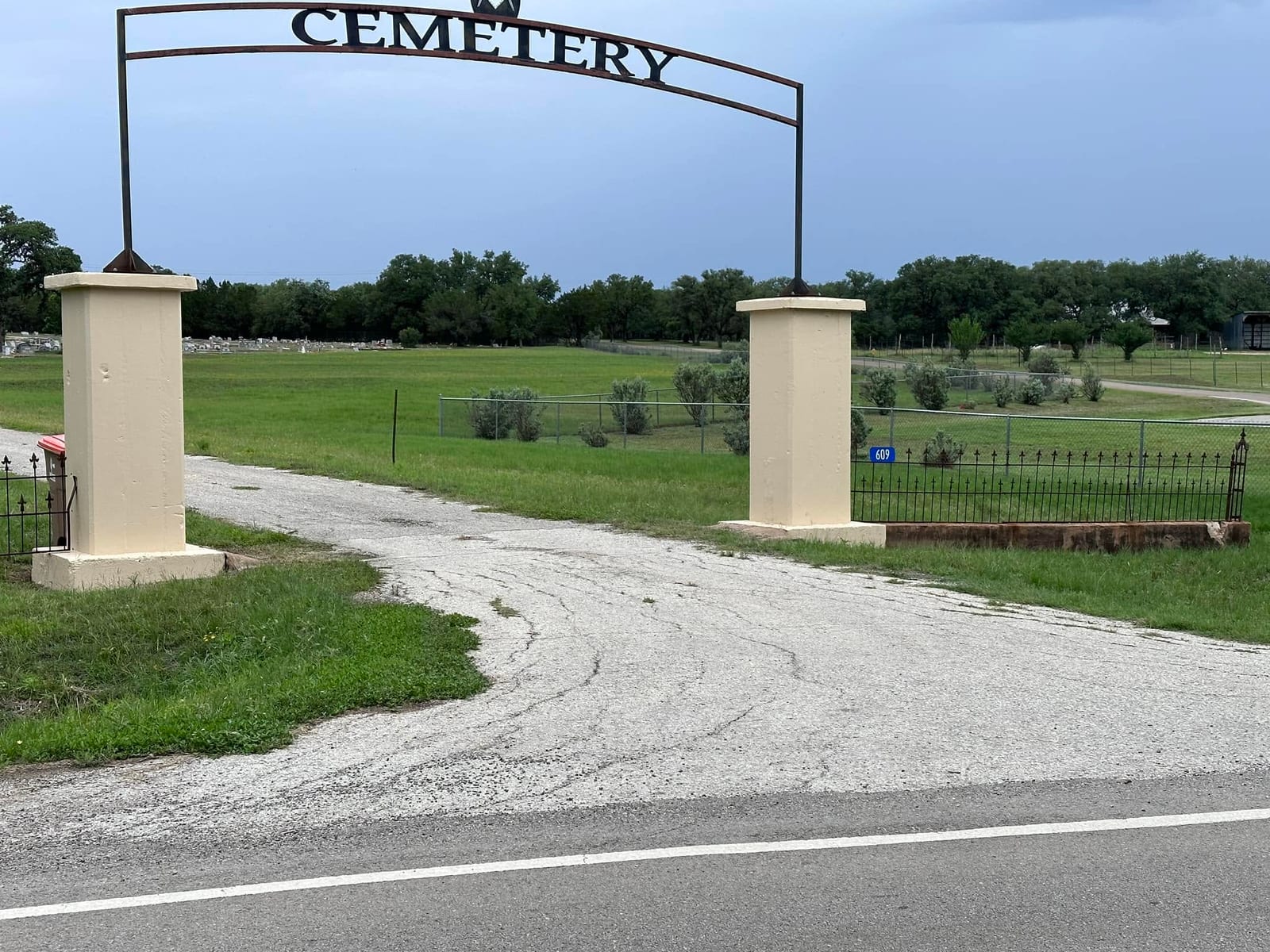
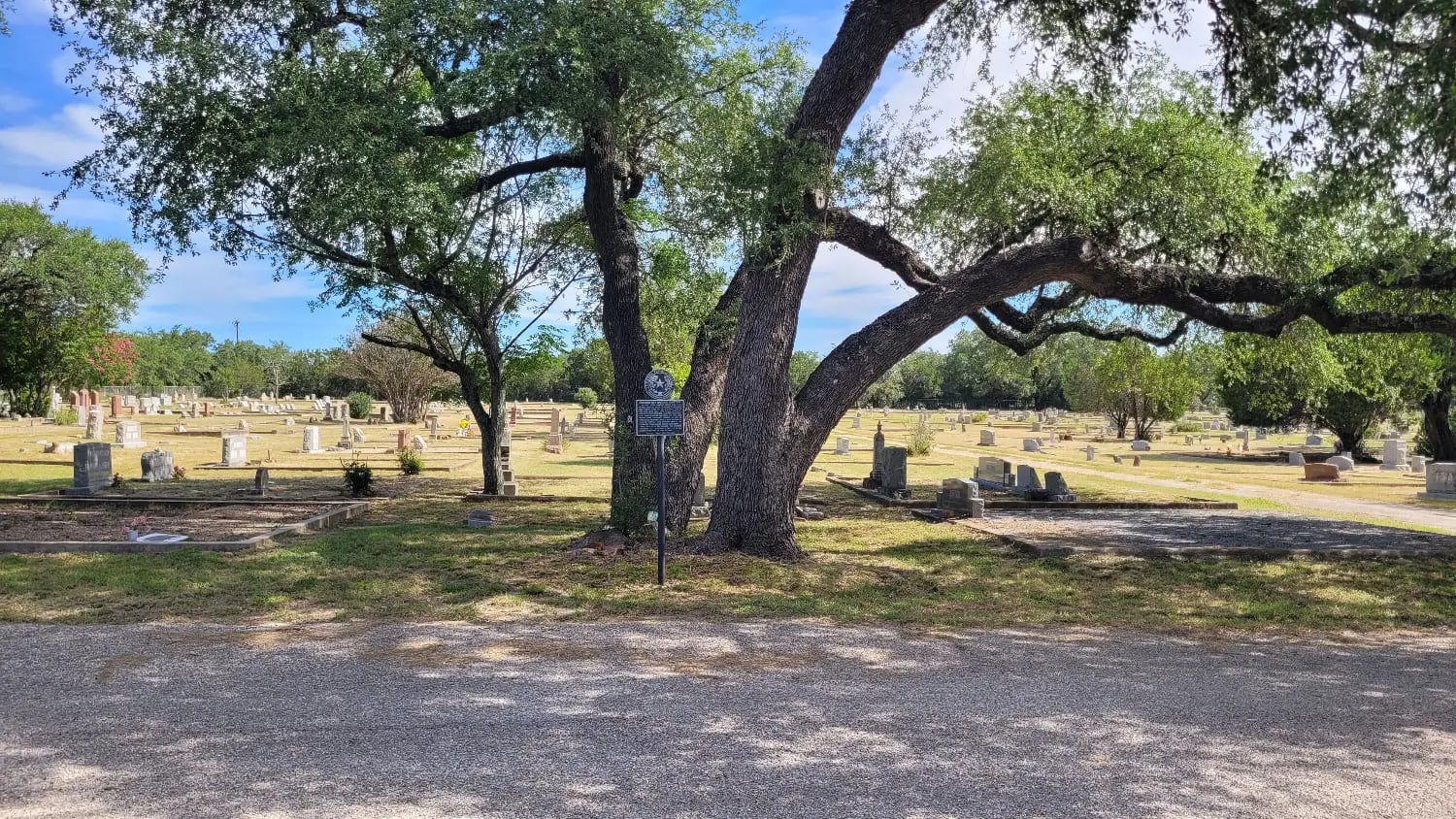
The Texas Historical Commission designates the Johnson City Masonic Cemetery a Historic Texas Cemetery and a state marker is dedicated at the entrance.
2007–08
Resurvey and formal dedication
Registered surveyor Floyd Ward resurveys the whole ground (July 6, 2007). In May 2008 the lodge, by Cemetery Committee chairman Mike Park and Worshipful Master Johnny Hudson, dedicates all 10.523 acres exclusively to cemetery purposes under §711.034 of the Texas Health and Safety Code. Casparis Sections A, B, and C are platted and recorded in May, October, and November 2008.
2025–26
A new lodge home on cemetery ground
After selling its 1951 building, the lodge votes to build its fourth lodge hall on the eastern section of the cemetery property, as the 2004 cemetery plan had anticipated. A granite columbarium is installed in Casparis Section B, along the west fence, so that families choosing cremation can rest here too.
Part four
Who looks after it
Two organizations share the work, and it helps to know which does what.
Johnson City Lodge No. 561 owns the land. Selling spaces, issuing deeds, keeping the plat and the record of who is buried where, maintaining the fences, buying and surveying new ground — those are the lodge's, through a Cemetery Committee the Worshipful Master appoints each year.
The Johnson City Masonic Cemetery Association keeps the grounds. Once a family buys a lot the lot is theirs, so the association was formed years ago by lot owners to pool the cost of mowing, trimming, and the slow, careful work of maintaining the curbed historic section. It is separate from the lodge, though many lodge members who own lots contribute to it. It is funded entirely by voluntary gifts.
There is no endowment behind either. What you see when you drive through the arch — cut grass, standing stones, a flag on the pole — is the product of volunteers and contributions, year after year, since 1892.